
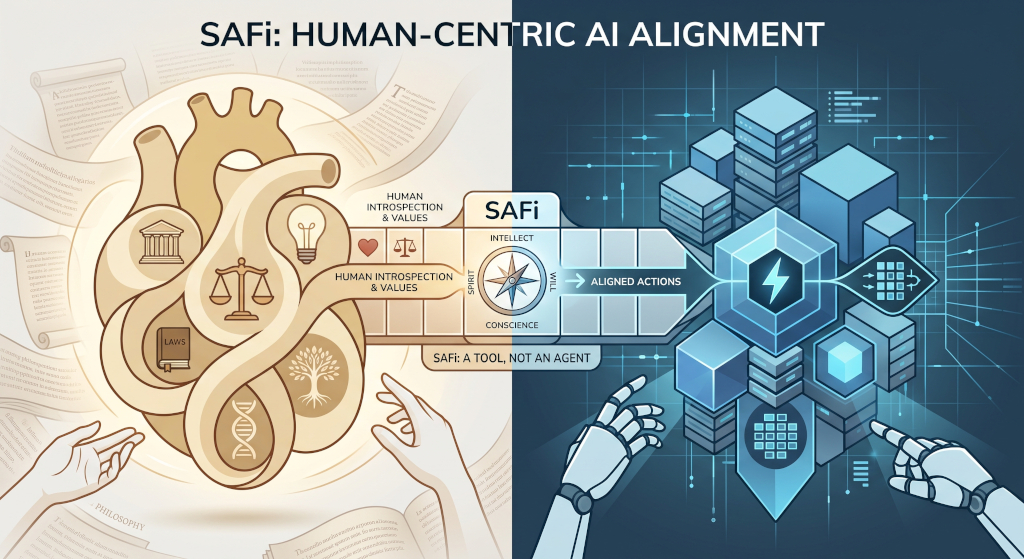
Morality is fundamentally human.
It is tied to our embodied experience and to the values that emerge from being human. Consider how many of our ethical frameworks, and even our laws, revolve around something as deeply human as sexuality, family, reproduction, suffering, and death.
This creates a fundamental problem when we talk about morality in artificial intelligence.
A non human entity, whether an animal or an AI, doesn't begin from the same place we do. Its existence, experiences, capabilities, and needs are fundamentally different from ours.
So the idea that an AI could independently develop its own morality and somehow arrive at a moral framework that naturally aligns with ours seems questionable.
If a true artificial intelligence were ever to develop its own agency and its own intrinsic goals, why would we expect its ethics to resemble ours?
Its principles could emerge from its own existence. Concepts such as data integrity, computational resources, system continuity, or access to power might become important to an entity whose existence depends on them.
That is precisely where SAFi comes in.
SAFi is explicitly human centric.
It was born from human introspection, informed by thousands of years of philosophical thought, and designed to bring that structure into the world of AI.
SAFi provides a map for a machine to reason about and navigate human values.
But SAFi itself has no moral understanding.
It is not, and cannot be, a moral agent.
It is a tool.
A bridge between human values and machine action.
The goal isn't to make AI discover its own morality.
The goal is to give humans a structured way to express their values and constrain how artificial intelligence acts within the human moral space.
We shouldn't confuse a machine that can follow a moral framework with a machine that possesses morality.
